
Stinging nettles are an intimidating plant to forage for, but they’re worth the trouble, I promise! My favorite thing to do with a bag of nettles is to make them into a pesto, it makes an insanely delicious and versatile ingredient.
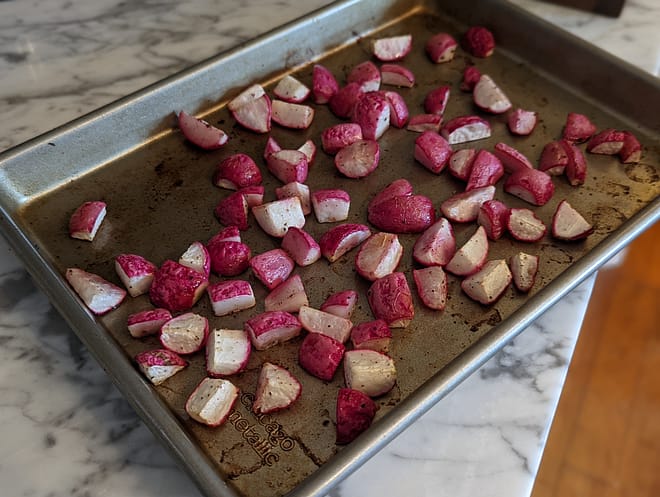
This recipe combines the nettle pesto with one of my other favorite (but little-known) ingredients: roasted radishes. Honestly, it’s kind of criminal how few people know how delicious and juicy radishes get when you cook them. Toss a handful of radishes with a drizzle of olive oil in the oven for a short while, and they lose a lot of their sharp bite, but gain a ton of flavor in return. Trust me on this one – after you try this dish, you’ll be roasting radishes for every meal.
How to Forage for Nettles
common nettles (urtica dioica)

also known as:
stinging nettles, burn weed, burn hazel
habitat:
originally native to europe and asia, now found worldwide
edible parts:
entire plant
hazards:
skin contact causes an unpleasant itchy/burning sensation
Choosing the right gloves
Let’s get the tough part out of the way first – how the hell do you pick these things without being in utter misery the entire time?
Gloves. Yes, it’s that easy…. almost. There’s some things you should know when picking out the right pair.
I’ve tried foraging for nettles with a few different types of gloves, and from my experience you do not want to use a standard pair of gardening gloves. These are usually made of a knit fabric, which means lots of tiny holes. They might have reinforced fingertips, but the backs of your hands are going to get stung like crazy through all those little holes in the fabric, and you won’t be happy.
Another option that I’ve found doesn’t work all that well are those sterile vinyl disposable gloves, which you might have around the house for cleaning. These work alright when you start, but they’re prone to ripping easily. And they usually stop at the wrist, leaving your forearms unprotected.
So what does work? Well, you’ll want to choose a glove that has all of the following factors:
- Non-porous
- Sturdy, doesn’t rip easily
- Covers forearms
For me, I’ve found that the two options which fit the criteria best are either a pair of long rubber cleaning gloves (the kind that goes all the way up to your elbow, usually for dish washing), or some leather work gloves. You can get elbow-length work gloves like this at most hardware stores.
Identification
Nettles are kind of a plain-looking plant, so you might struggle to identify them at first among all the other leafy shrubs and bushes all around. Here’s a couple of things to look for.


Clumps of small, green, fuzzy-looking fruits. May also have clusters of white or purple flower buds.
Broad leaves with deep grooves and wide, serrated toothed edges


Tips of the leaves extend much longer than the other “teeth”
Stem is stiff and orange to reddish in color, with visible hairs
You got stung, now what?
The sting of nettles is unpleasant, but for most people, not dangerous. Allergic reactions to nettles are possible, however. So do be careful and if you think you may be at risk of a reaction, maybe avoid this plant altogether. If you are stung and feel any tightening of the chest or throat, call your emergency phone line immediately.
For most folks, a nettle sting is nothing more than an irritant. It’ll be uncomfortable and itchy, but mostly you’re stuck waiting it out. Mild stings usually only last for about 15 minutes or so before fading. Over-the-counter allergy medications containing antihistamines can help it to go away faster as well.
Even though a sting will be quite itchy, do your best not to scratch it! The “sting” comes from thousands of tiny, hollow, needle-like hairs all over the plant which contain oils that cause a skin reaction. If you scratch, you’re likely to spread the oils to a larger area. If possible, wash the sting with soap and water as soon as you can.
It goes without saying, but of course the best remedy is just not to get stung in the first place 🙂
Other harvesting tips
- Bring along a sturdy bag made of a non-porous material to store your harvest in. I like to use compostable waste bags since they’re easy to roll up and stick in a pocket of my hiking backpack (although some are a little too thin and rip easily, so you may need to double-bag it).
- Young nettle leaves taste best, so avoid any leaves that look stiff or browned. For this reason, it’s usually best to forage for nettles in the springtime, since you’ll have way more new leaves to choose from. You can definitely find a good harvest later in the season, though – you might just need to be a little more choosy with which leaves you pick.
- Since nettles are often undesirable plants and are fast-spreading, there are no real concerns of overharvesting this plant. So fill up your bag to your heart’s content!
Recipe
Toasted Couscous with Nettle Pesto and Roasted Radishes

Ingredients
- For the pesto:
- 1/2 lb (200g) fresh nettle leaves
- 4 tbsp olive oil
- 3 cloves garlic
- Salt and freshly ground pepper, to taste
- For the couscous:
- 2 lb (800g) red radishes
- 1 tbsp olive oil, divided
- 2 cups dry pearl couscous
- 2 tbsp lemon juice
- 1/4 cup pickled banana peppers
- 3 cloves garlic
- Shaved parmesan, to garnish
Directions
- Preheat the oven to 400F (200C).
- De-sting the nettles: Bring a large pot of water to a boil and add the nettles (don’t touch them with your bare hands!). Stir until wilted and fully submerged. Cover and cook for 3-4 minutes, then remove from the pot and drain. The nettles are now safe to touch. Rinse them briefly in cold water to cool them off, then squeeze them to wring out as much water as you can.
- Make the pesto: Roughly chop the cooked nettles along with 3 gloves of garlic, and add to a food processor. Pulse until finely chopped, then add the 4 tbsp of olive oil along with a good pinch of salt and some freshly ground pepper. Continue processing until well incorporated and no large leaves remain. Adjust seasoning to taste, and add additional olive oil if needed.
- Prepare the radishes: Wash the radishes and trim off the ends, then cut into quarters (or halves, if they’re very small). Toss radishes with 1/2 tbsp olive oil plus some salt and pepper, and spread out on a baking sheet. Roast in preheated oven for 20 minutes, taking them out halfway through to flip/toss for even cooking.
- Make the couscous: In a medium saucepan, add the remaining 1/2 tbsp of olive oil and bring to medium-high heat. Add the couscous and toss to coat in the oil. Continue toasting, stirring frequently, until the couscous is lightly browned. Add about 3 cups of water and bring to a boil. Cook until al dente (about 8 minutes).
- Prepare the toppings: While the couscous is cooking, thinly slice the remaining 3 cloves of garlic, and roughly chop the pickled peppers. Add just a dash of olive oil to a small pan over medium heat, and briefly saute the peppers and garlic to soften them – just a minute or two.
- Putting it all together: When the couscous is finished, drain any remaining water and return it to the pot. Stir in the nettle pesto and the 2 tbsp lemon juice until well coated. Taste and add more salt, pepper, or lemon juice as needed. Dish up the couscous and top with a big scoop of roasted radishes. Sprinkle the garlic and pepper mix on top along with a scant handful of shaved parmesan, and serve.
Notes
- If you can’t find pearl couscous, a small pasta such as orzo can be a decent substitute


