
common yarrow (achillea millefolium)
also known as:
yarrow, milfoil
habitat:
nearly everywhere except parts of africa and southern asia
edible parts:
entire plant
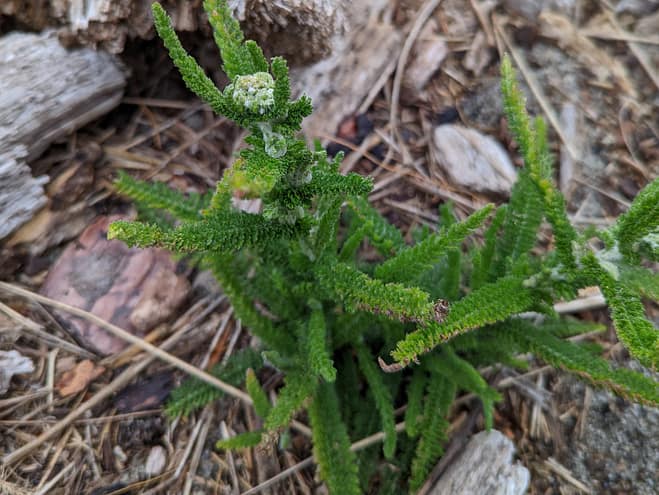
Yarrow is a plant that’s easy to recognize, it’s got these frilly feathery leaves that really don’t look like anything else that I can think of. Mature yarrow plants will also have bunches of little white flowers at the tops that look kinda like queen anne’s lace, but the ones I saw when I took the photos for this post were mostly younger plants, which just have these cute fuzzy balls of future flowers that haven’t bloomed yet.
You can find it pretty much anywhere across the world; it’s native to temperate areas in the northern hemisphere, but has been introduced in much of the southern hemisphere as well. It’s a hardy plant that doesn’t need much to grow, so you’ll often see it widespread in places that other plants have trouble flourishing in – like in sand or on rocky mountainsides. In many places it’s considered invasive, so you don’t need to worry about overharvesting it.
The good news about yarrow is that the whole plant is edible. The bad news is you probably don’t want to. It’s bitter stuff, and has this strong medicinal sort of smell to it. Yarrow is a common ingredient in traditional medicine, and still today there are a lot of claims out there about different health applications of it. But that’s not the kind of forager I am, so we’ll just skip that part, yeah?
Medicinal claims aside, I’ve definitely heard the words “yarrow tea” used in a positive way before, I think. And I like to try everything even if it seems like a bad idea1especially if it seems like a bad idea, so I have prepared yarrow tea before. Here’s how I made it and what I thought about it.
Yarrow tea recipe – the short version
recipe: dried yarrow tea
Ingredients
- freshly harvested yarrow leaves
Directions
- Rinse thoroughly to remove any dirt or debris. Dry in a salad spinner if you have one, or just pat dry with a clean towel.
- Strip the frills from each leaf stem. They should come off easily by just grasping the stem tightly and running your fingers down it.
- Spread yarrow leaves in a single layer in a dehydrator. Dry at 90F (32C) for a few hours or overnight, until leaves are completely dried and brittle.
- Store in an airtight container until ready to make tea.
Yarrow tea recipe – the long version
Usually when I pick something I haven’t tried before, I start with the good old scratch-and-sniff technique. It releases all the oils in the leaf, so it’s a good way to get the “essence” of a plant. When I did this with yarrow, I got smacked in the face with a strong, bitter smell. This tempered my expectations a lot of the final result, so I didn’t pick a whole lot of it. Just one or two small plants.


I gave the leaves a good rinse, but didn’t really bother removing the dried out brown leaves. I figured that I’m going to be drying it anyway, so why waste the effort?
The leaves seemed less bitter than the stems, so I focused on those and tossed the stems out. I just sat down and stripped the frilly bits off each stem by pinching them and running my fingers down it.
This was my favorite part actually. Very meditative and satisfying.


I ended up with maybe around a cup and a half of leaves after I was finished. I forgot to actually weigh it though.
These were then spread on a dehydrator tray, along with a bunch of other things I’d foraged that day, and left to dry overnight at about 90 or 100 degrees F.
And after all that effort, the result was a pretty gross tea, at least to my tastebuds. It was really bitter with a strong medicinal/piney smell2actually though I’d describe IPAs in the same way and a lot of people seem to like those, so maybe some people would really enjoy this tea.. My partner didn’t hate it as much as I did, so take my opinion with a grain of salt. Could be something you develop a taste for. I could also see some potential usecase where you add this to a sweet tea blend to balance it out maybe.

FORAGING SCORE: 9 / 25
VERDICT: bitter and medicinal, hard pass.
| ease of harvesting / preparation | 4 / 5 some effort but it was pretty chill, I liked the process of removing the leaves |
| edibility | 2 / 10 I can see this being good as a balancing element in an otherwise sweet tea. also maybe if you like bitter piney flavors you might dig this, idk. |
| overall enjoyment | 3 / 10 it’s quite pretty, I’ll probably plant some in my yard. but not for eating, for me anyway |
footnotes
- 1especially if it seems like a bad idea
- 2actually though I’d describe IPAs in the same way and a lot of people seem to like those, so maybe some people would really enjoy this tea.